André Barbault
1921 – 2019 · The father of French humanistic astrology

Photo: Wikimedia Commons · CC BY-SA
Few figures cross an entire century and leave behind a body of work that outlasts them. André Barbault is one of those rare exceptions. Astrologer, humanist and tireless researcher, he spent seventy years giving astrology the rigour, psychological depth and intellectual dignity that few had dared claim for it.
He died in 2019, aged 97. His books are still read. His methods are still taught. And his final great prediction — formulated in 2011 — came true in 2020 with a precision that silenced those who had ignored him.
Who was he?
André Barbault was born on 1 September 1921 in Chémery-sur-Bar, in the Ardennes region of France. He discovered astrology very young, in the 1940s, at a time when the discipline was still largely scorned in French intellectual circles. Far from being discouraged, he made it his cause: to show that astrology could be a serious, rigorous discipline, useful for understanding both human nature and history.
In 1949, he founded the Centre International d'Astrologie — the first institution of its kind in France, dedicated to gathering researchers, sharing methods and creating a framework for astrological teaching. In 1969, he launched L'Astrologue, the reference journal he would edit for decades.
What distinguishes Barbault from his contemporaries, however, is not merely longevity or prolific output: it is vision. He was the first French astrologer to engage seriously with Freudian psychoanalysis — and to make it the backbone of a deeply humanistic astrology, turned not toward the prediction of external events but toward the understanding of the human soul.
— André Barbault
His method: astrology as a science of history
While his contribution to psychological astrology is immense, Barbault is perhaps even better known for his work in mundane astrology — the study of planetary cycles to understand the great collective and historical trends of human civilisation.
The Planetary Concentration Index (PCI)
At the heart of his method lies an original invention: the Planetary Concentration Index. The idea is simple in principle, complex in its implications.
Barbault measures, at any given moment, the total angular distance between the slow-moving planets (Jupiter, Saturn, Uranus, Neptune, Pluto). When the planets are clustered together (high concentration), the PCI is low — and history shows that these periods consistently coincide with major crises: wars, pandemics, economic collapses.
When the planets are spread apart (low concentration), the PCI is high — and the corresponding periods tend toward stability, expansion and reconstruction.
This is not mysticism. It is a cyclical and statistical method, verified across several centuries of world history.
What he predicted — and what came true
The power of Barbault's work lies not in vague or retroactive predictions. His analyses, published before the events, constitute a rare and striking archive:
- The 1930s and the Second World War — Barbault demonstrated, through retrospective study of planetary cycles, that the planetary concentration of the 1940s was the highest in centuries — identical to the configurations that had produced the deepest crises of modern history.
- The 1974 economic crisis — he published in advance an analysis pointing to 1973–74 as a period of high planetary concentration, coinciding with the first oil crisis.
- The fall of the Berlin Wall (1989) — his method signalled a turning point around 1989, corresponding to the collapse of the Soviet bloc and the end of the Cold War.
- The 2008 financial crisis — identified well in advance in his writings on the Saturn-Pluto cycles.
- The global crisis of 2020 — his most celebrated prediction. Formulated in L'Avenir du Monde (2011), nine years before the fact: a major collective crisis around 2020–2021, linked to the conjunction of Jupiter, Saturn and Pluto in Capricorn — the exact configuration that accompanied the COVID-19 pandemic.
Timeline
His major works
Barbault wrote more than thirty books. Here are the essential ones:
De la Psychanalyse à l'Astrologie
His founding work. He establishes the dialogue between Freud and the planets, laying the foundations of French humanistic astrology.
View on Amazon →Traité Pratique d'Astrologie
The reference manual. Dense, rigorous, pedagogical — the one French-speaking astrologers still keep on their shelves.
View on Amazon →Traité d'Astrologie Symbolique
An in-depth exploration of planetary and zodiacal symbolism, at the crossroads of mythology and psychology.
View on Amazon →Dictionnaire de l'Astrologie
The encyclopaedia of the discipline — a reference tool that has trained generations of astrologers.
View on Amazon →Les Astres et l'Histoire
His most ambitious work on mundane astrology: planetary cycles mapped against five centuries of history.
View on Amazon →L'Avenir du Monde
His final great work. He predicted the 2020 crisis nine years in advance, and charted the major trends through to 2040.
View on Amazon →Barbault's Basket — his 2026 configuration
It is in the context of his work on mundane astrology that what we now call Barbault's Basket takes on its full meaning: an exceptional planetary configuration forming in July 2026, gathering Jupiter, Neptune, Uranus and Pluto in six simultaneous aspects that form the characteristic shape of a basket.
This configuration, combined with the Planetary Concentration Index, represents a rare moment in planetary history — a potential turning point comparable to the great historical pivots of the 20th century that he studied his entire life. We have dedicated a full article to it, detailing each aspect, the planets involved and what Barbault's method suggests for the years ahead.
Discover Barbault's Basket 2026 →Hear him speak
Few have loved teaching as much as he did. André Barbault was a convinced educator — and the interviews that still circulate on YouTube reveal the clarity of his thinking and the gentleness of his way of explaining complex ideas. Click to watch directly here.
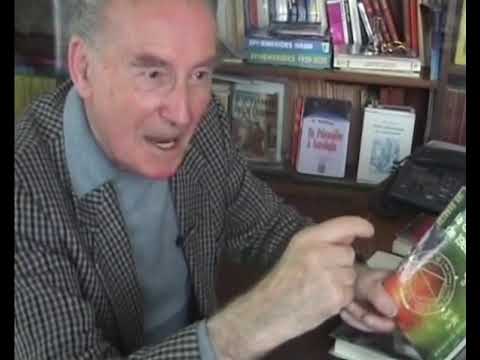
Interview 1
André Barbault presents his method, the Planetary Concentration Index and his major world predictions.
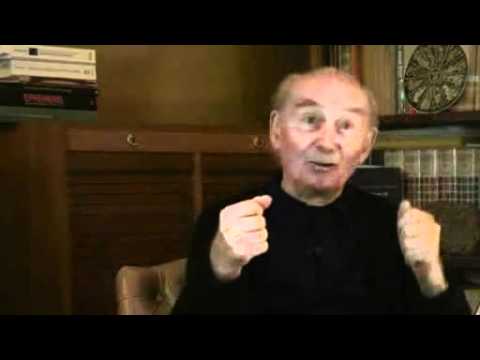
Interview 2
A second interview going deeper into his vision of planetary cycles and mundane astrology.
External YouTube content · plays within this page
Frequently asked questions
Was André Barbault a professional astrologer?
Yes — he devoted his entire adult life to astrology, as a researcher, author, teacher and editor. He founded the Centre International d'Astrologie in 1949 and edited the journal L'Astrologue for decades. He never presented himself as a fortune-teller or seer, but as a researcher in search of a deeper understanding of human cycles.
Was his 2020 prediction really published before the fact?
Yes. In L'Avenir du Monde, published in 2011, Barbault identified 2020–2021 as a period of major collective crisis, linked to the conjunction of Jupiter, Saturn and Pluto in Capricorn. That exact conjunction occurred in January 2020, just weeks before the WHO declared the COVID-19 pandemic. His method did not predict the precise nature of the crisis — but it correctly identified the time window and the intensity.
What is the difference between classical astrology and the humanistic astrology he championed?
Classical astrology tends to predict external events ("you will meet someone in March"). Humanistic astrology — the current of which Barbault is one of the founding fathers in France — is primarily concerned with inner dynamics: psychological tendencies, personal cycles, potentials. It draws on psychoanalysis and considers the birth chart not as a fixed destiny, but as a map of the soul.
Where can I find his books?
Most of his works are available on Amazon or in specialist bookshops — the links above point directly to each title. The Traité Pratique d'Astrologie and L'Avenir du Monde are the most accessible starting points. Some are out of print but can be found second-hand — a search always worth making.
People have asked this for three thousand years. What does it say about you?
Wooly reads the archetype you actually carry — your gifts, what drains you, and the shape of your best work.
✦ Your Soul Archetype → $8.99