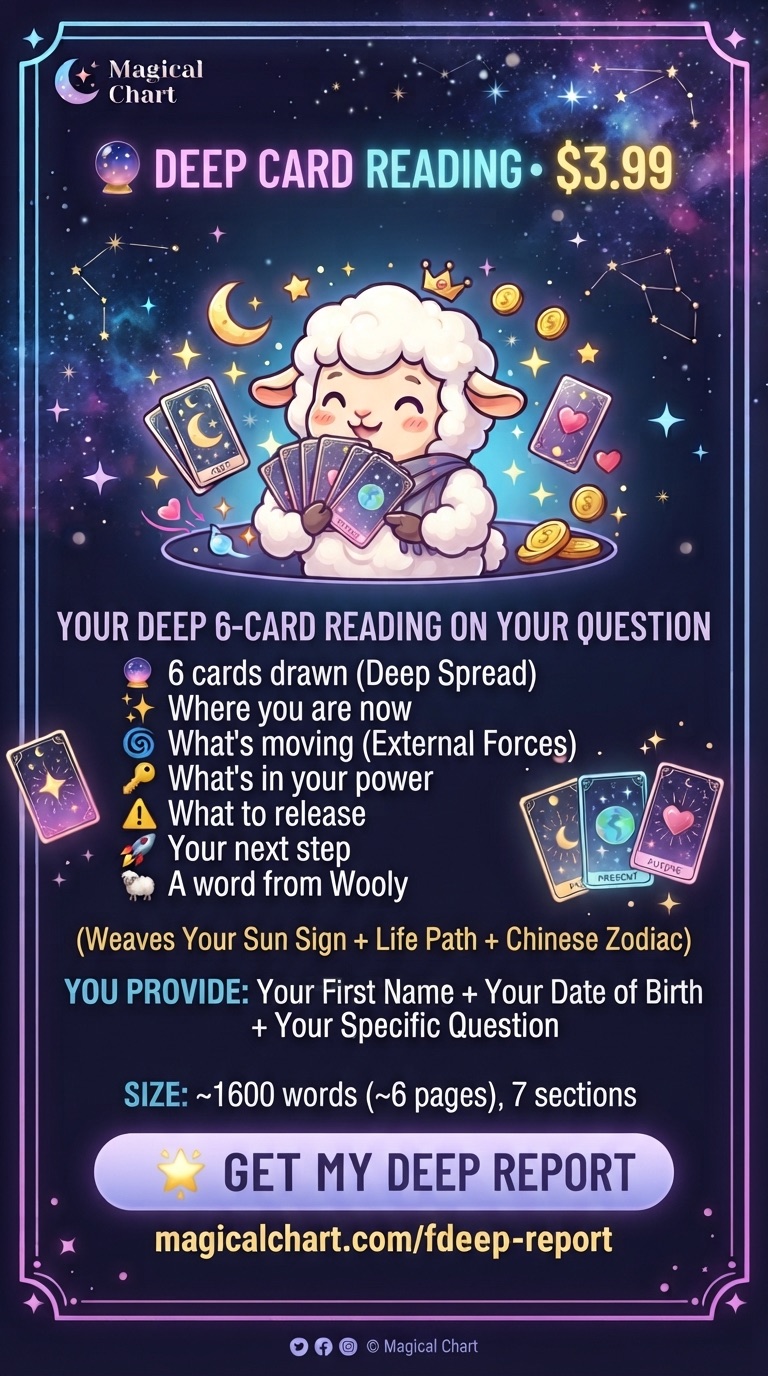
You bring one real question — about love, a decision, a crossroads, a person, a fear — and Wooly draws six tarot cards and reads them as one connected story: where you stand, what's stirring beneath the surface, what's truly in your power, and the one step that's yours to take. It's honest and empowering — never a fixed prediction, and never designed to leave you waiting or hoping.
For reflection & entertainment only. Magical Chart readings gently highlight tendencies and energies — they are not predictions, and not professional medical, legal, financial or psychological advice.
What is a deep tarot card reading?
A deep tarot card reading is a focused interpretation of one real question, rather than a general card meaning copied from a dictionary. Wooly reads a six-card spread around your situation: what is shaping it, what may be hidden, where your agency is, and what to consider next.
The useful question is specific. You might ask about a decision, a relationship, a change at work or a pattern you cannot stop repeating. The reading is written as reflection, not certainty. It does not replace a professional decision, but it can give you a structured way to name the tension and the choices in front of you.
A one-off reading is different from Premium: you pay once, receive one answer, and do not subscribe. If you are looking for a broader year-long or relationship reading, explore the Year Ahead Reading or the Love & Compatibility Report.
Questions people ask
What is a good question to ask in a tarot reading?
A question works when it is specific and open. “What should I pay attention to in this job offer?” gives a reading something to work with. “Will I get the job?” does not, because a card cannot know and anything that answers it is guessing.
The best questions are about your own position: what you are avoiding, what you are weighting too heavily, what you would do if the decision were already made. Those are questions reflection can actually move.
What should you not ask a tarot reading?
Anything where a wrong answer costs you something real. Medical questions, legal questions, whether to take a medication, whether someone is cheating, when a person will die. We do not answer those, and a reader who does is taking a risk with your life on your behalf.
Also avoid questions about what a third party is secretly thinking. A reading has no access to another person’s mind, and pretending otherwise tends to keep people stuck.
Can you ask the same question twice?
You can, and many people do. What is worth noticing is why. Re-asking usually means the first answer was unwelcome rather than unclear, and a second draw rarely resolves that.
If you find yourself re-asking, a more useful move is to change the question. Instead of asking again whether to leave, ask what would have to be true for staying to be a good decision.
How is a deep reading different from a free one?
The free reading draws a card and gives you its meaning in context. That is genuinely useful and costs nothing, and for most questions it is enough.
The deep reading is a six-card spread written around one specific situation: what is shaping it, what may be hidden, where your agency is, and what to consider next. You are paying for length and structure, not for a better answer.
Does the reading predict what will happen?
No. It is written as reflection, and we would rather lose a sale than imply otherwise. Nothing in a spread establishes a future event, a date or an outcome.
What a spread can do is lay out a situation in parts so the choices become visible. People often find that the useful moment is noticing which card they argued with.
What do I actually receive, and how fast?
One written reading of about five pages, built on the question you type and the six cards drawn for it, delivered immediately. One payment, no subscription, no renewal.
The cards are always drawn at random. The reading interprets what came up; it never picks a card to fit a story. If you want to see the format before paying, the reading examples page shows real ones.
Is this suitable if I am going through something serious?
If what you are carrying is heavier than a reading, a reading is the wrong tool and we will say so rather than take your money. Grief, a diagnosis, an unsafe relationship or thoughts of harming yourself need a person, not a spread.
For ordinary difficulty, the kind you could describe to a friend over coffee, a structured reflection can genuinely help you name what is happening. That is the honest scope of it.
Why six cards rather than three or ten?
Three cards tend to collapse into a single storyline, and ten give you more threads than most questions can carry. Six leaves room for a situation, a counterweight, something unseen and a direction, without turning the reading into a catalogue.
It is a judgement about readability, not a claim about the number six. If you want the ten-position version for a genuinely complicated situation, the Celtic Cross reading is built for that.