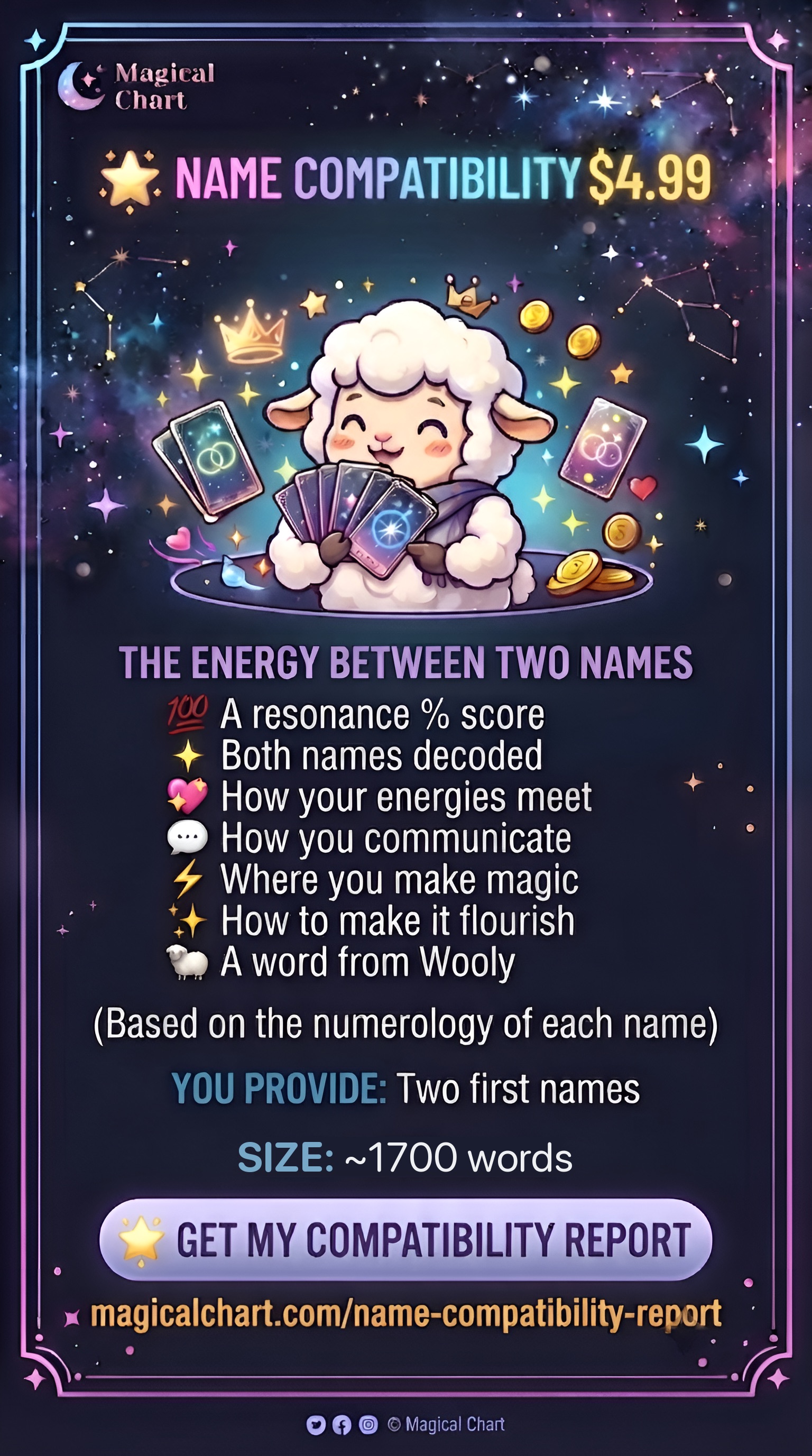
Every name carries a vibration — the numerology of its letters hints at how a person expresses, connects and loves. A name compatibility reading looks at two names together: where their energies harmonise, how they communicate, where they may rub, and how the pair can flourish. It's warm and honest — a mirror of the energy between you, never a fixed verdict on your future.
Prefer a free version first?
Of course. Try the free Name Compatibility calculator or a free love reading with Wooly — no payment. The deep Name Compatibility Report above is for when you want the full, personal reading of your two names.
For reflection & entertainment only. Magical Chart readings gently highlight tendencies and energies — they are not predictions, and not professional medical, legal, financial or psychological advice.
What is a name compatibility reading?
A name compatibility reading explores the symbolic pattern created by two names: what seems to bind the connection, where the energies may clash and what each person might learn from the relationship. It is designed as a playful reflective reading, not as a scientific test or a guarantee that two people belong together.
Names can be a way into a question, but real compatibility is built through behaviour. Communication, respect, reciprocity, boundaries and shared values matter more than any number calculated from letters. Read the report as a prompt for curiosity about the connection, not as permission to ignore what is happening in real life.
You map each letter to a number, add them, and reduce the total to a single digit. Vowels alone give what is traditionally called the Soul Urge, consonants the Personality, and the whole name the Expression. Different schools use different letter maps, so the same name can produce different numbers depending on whose system you follow.
Our report shows the numbers it derived and names the tradition it used, rather than handing you a figure with no working. If a tool will not tell you how it got there, you cannot disagree with it, and that is not a feature.
How do I know if my name is good in numerology?
You cannot, because every number in the system carries both a strength and a cost. The number linked with drive is also linked with impatience; the one linked with harmony is also linked with conflict avoidance. A system in which nothing is purely good cannot rank names.
So we do not score names. The report describes what each number is associated with, including the part that is inconvenient, and leaves the judgement to you.
How do you choose a baby name using numerology?
We would rather you did not. Choose a name for the reasons that will still matter in thirty years: how it sounds, what it carries in your family, whether it travels across languages, whether the child can spell it at five.
Run it through a calculator afterwards if you are curious. Treating a symbolic sum as a reason to reject a name you love puts a tradition above your own judgement, and the tradition has not earned that.
Which numbers are said to work well together?
Common pairings place 1 with 5 and 7, 2 with 6 and 8, 3 with 9. Other tables disagree, and we will not pretend one of them is authoritative.
What is more useful is the direction rather than the pairing. Two numbers associated with initiative will probably describe a household where nobody wants to handle the admin. That is an observation you can test tonight.
What does the report include, and what does it not?
It includes the numbers derived from both names, what each is traditionally associated with, where the two descriptions pull against each other, and one practical thing to notice. One payment, about five pages, no subscription.
It does not include a compatibility percentage, a prediction about the relationship, or advice about whether to commit. For a reading built on birth dates rather than names, compare the Love & Compatibility Report.
Why do two calculators give different numbers for the same name?
Because there is more than one letter-to-number table. The Pythagorean system assigns one to nine across the alphabet in order; the Chaldean system uses a different mapping and omits nine. Both are in active use, and neither is the original.
A tool that does not say which table it used cannot be reproduced, and a result you cannot reproduce is not a result. We name ours.
Does it matter which name I use?
The tradition disagrees with itself here too. Some practitioners insist on the full name as registered at birth, others use the name you actually go by, others read both and compare.
Our report uses what you enter and says so. If you have changed your name, reading both is the more interesting exercise: the difference between the two descriptions is usually closer to the real question than either one alone.