✦ The Moon
Blood Moon
meaning
When the moon turns red: endings and transformation.
When the moon turns red: endings and transformation.
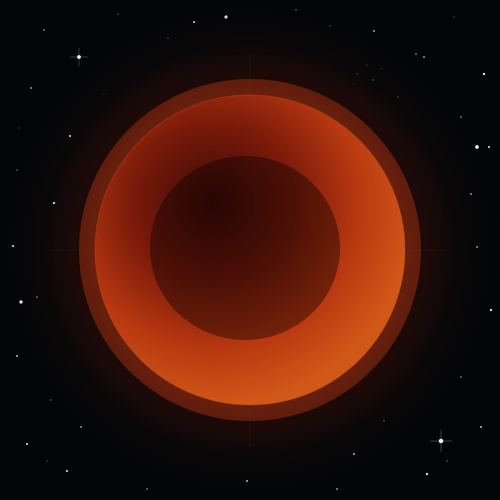
A blood moon is a total lunar eclipse — one of the most dramatic astronomical events visible to the naked eye. During a total lunar eclipse, the Earth passes directly between the sun and the full moon, casting its shadow across the moon’s surface. The moon doesn’t go dark. Instead, it glows a deep, vivid coppery red — a colour dramatic enough to earn the name "blood moon" across many cultures and centuries.
Astronomically, the redness is caused by Rayleigh scattering: sunlight bending around the edges of the Earth’s atmosphere reaches the moon, but the blue wavelengths scatter away (as they do in a sunset) and only the longer red wavelengths make it through. The moon is lit by every sunset and sunrise happening simultaneously around the Earth’s rim. It’s one of the most beautiful phenomena you can witness without a telescope.
A total lunar eclipse requires a very specific alignment: the sun, Earth and moon must be almost perfectly in line, with the Earth’s shadow (the umbra) falling entirely across the moon. This happens only at a full moon, and only when the moon’s orbit intersects the ecliptic plane at the right moment. The result can last for over an hour of totality — during which the moon passes through shades of orange, copper and deep red, sometimes almost disappearing, depending on atmospheric conditions.
Notably: a blood moon can only occur at a full moon. An eclipse amplifies the already-heightened energy of a full moon — making it considered one of the most powerful moments in the entire lunar calendar.
Across cultures and through history, total lunar eclipses have been regarded as significant and sometimes portentous events. The dramatic visual of the moon "turning blood red" made them easy to interpret as signs of endings, revelations or transformation. Modern spiritual frameworks have carried this forward:
Astrology traditionally treats eclipses as powerful accelerators: chapters that might have taken months close in days. What has been building under the surface comes up. Situations reach their conclusion. This makes the period around a blood moon simultaneously potent and turbulent — a lot can shift in a short time, and not always in the way you planned.
Many traditions suggest working with this energy rather than against it: resting into the movement rather than trying to control or direct it. The blood moon tends to do its own work, and your role is more to witness and allow than to initiate and force.
Slow down. Journal what feels like it’s ending or completing. Sit with strong feelings rather than pushing them away. Be tender with yourself — eclipse periods often bring up what’s been suppressed, and that can be intense. Rest, observe, let yourself feel.
Many traditions advise against starting new projects, making major decisions or setting fresh intentions during a total lunar eclipse — the energy is considered turbulent and unpredictable. Act in the days after, once the dust has settled and you can see more clearly what the blood moon revealed.
If the blood moon is visible from where you are, go outside and watch it. It’s rare, beautiful, and one of the few astronomical events that connects you viscerally to the sky as something alive and in motion. The experience itself is the practice.
"The moon commands nothing — it just offers a gentle rhythm to move forward, then rest. 🐑"
A blood moon is the popular name for a total lunar eclipse, during which the moon enters Earth’s shadow and glows deep coppery red — caused by sunlight bending through Earth’s atmosphere. It is one of the most dramatic visible astronomical events, occurring a few times per decade at any given location.
It’s read as an amplified full moon combined with the accelerating energy of an eclipse: endings, deep transformation, truth surfacing, powerful release. Many spiritual traditions treat it as a moment of closure and revelation rather than a time to begin new things.
Many traditions advise observing and resting rather than performing intentions or manifestation rituals — eclipse energy is considered too turbulent for new beginnings. A journal, some quiet time and gentle presence are more aligned with blood moon energy than setting new goals. Act in the days after, when the sky has settled.
During a total lunar eclipse, the Earth blocks direct sunlight from reaching the moon. Sunlight bending around Earth’s atmosphere reaches the moon instead, but blue wavelengths scatter away (the same process that makes sunsets red/orange). Only the long red wavelengths reach the moon — making it glow the signature deep copper-red.
Total lunar eclipses happen roughly two or three times per year globally, but their visibility depends on your location — a single blood moon may only be visible from part of the Earth. From any given place, you might see a blood moon once every year or two on average.
The sky moves for everyone. It does not land the same way on you.
Your cosmic calendar: the favourable windows of your year, month by month, dated.
✦ Your Cosmic Calendar → $9.99For wellbeing & reflection ✦ A symbolic marker and a gentle rhythm — nothing required, nothing medical. 🌙