Your Moon and theirs
Two birth dates are enough. Wooly works out the exact Moon that hung over each of you — the real one, computed — and shows whether the two shapes complete each other into a whole circle.
What “complementary” actually means here
A Moon phase is one number: the angle between the Sun and the Moon as seen from Earth. At 0° the Moon is dark, at 180° it is full. Everything in between is a slice of light travelling across the same face.
Two phases complete each other when their two angles add up to a full turn — one waxing, the other waning by the same amount. Put side by side, the lit part of one is exactly the dark part of the other. It is a real geometric property, not a metaphor laid on top: the two shapes genuinely form one whole circle.
That is why this page draws a third Moon. The score is not a formula sitting next to a picture — it is measured on the picture: the share of the disc your two Moons light between them.
The eight phases, and what each one is said to carry
The Moon takes about 29.5 days to go from dark to full and back. Tradition divides that journey into eight stages. Yours is whichever stage the sky had reached on the day you were born.
| Phase | Lit | The temperament traditionally attached to it |
|---|---|---|
| New Moon | 0–2% | Beginnings. People who start things easily and get restless once they are running. |
| Waxing Crescent | 3–45% | Momentum. Curious, hopeful, more comfortable building than finishing. |
| First Quarter | ~50% | Decision. Meets resistance head-on; tends to force the issue rather than wait it out. |
| Waxing Gibbous | 55–98% | Refinement. Adjusts, improves, polishes — and can struggle to call anything finished. |
| Full Moon | 99–100% | Culmination. Feels everything at full volume, and is often the one others read the room through. |
| Waning Gibbous | 55–98% | Transmission. Explains, teaches, passes on what was learned. |
| Last Quarter | ~50% | Release. Reassesses, drops what no longer holds, sometimes abruptly. |
| Waning Crescent | 3–45% | Retreat. Needs quiet before the next cycle, and rarely apologises for it. |
These readings are traditional, not measured. The phase is astronomy; what it says about a temperament is symbolism, and this page keeps the two clearly apart.
What your particular pairing suggests
Opposite phases — the two shapes close the circle. One of you was born as the light was growing, the other as it was letting go, by the same amount. This is the pairing the internet calls a “moon phase soulmate”. What it describes is not sameness but coverage: what one of you finds difficult tends to be the other’s default setting.
The same phase — the shapes overlap. You were born at nearly the same point of the cycle. Ease, because you recognise each other without explanation. And a shared blind spot, because you also run out of patience at the same moment, for the same reason.
A quarter apart — the shapes lean. Neither mirror nor twin. There is friction, and it is the productive kind: enough difference to be surprised, enough overlap to be understood.
New and Full together. The extreme case of complementarity: one born in complete dark, the other in complete light. Together they cover the whole disc with nothing to spare and nothing missing.
Which birth dates give the strongest match?
The Moon's cycle is about 29.5 days from dark to full and back — so its phase moves forward at a steady pace, roughly one full stage every few days, for everyone alive, regardless of the year. That means the two opposite-phase birth dates are always the same distance apart: about 14–15 days, in either direction. Someone born 14–15 days before or after you was born at very close to the opposite point of the cycle — the strongest complementary pairing this page measures, whatever year either of you was born in.
It repeats: 14–15 days, then again roughly every 29.5 days after that (about 44 days, 74 days, and so on) will also land near an opposite phase. But the nearest and simplest one to look for is the first: a birthday about two weeks apart from yours.
Do I need a birth time?
No — and that is deliberate. The Moon moves about 13° a day, so without an hour its phase can shift by up to half a day’s worth of light. That is enough to move a borderline case from one phase name to the next, and not enough to change the shape you see: at the scale of this drawing, half a day is a fraction of a pixel.
What a birth time would add is the Moon’s exact degree, its sign, and the houses — none of which this page claims. If you want those, the birth chart asks for the hour and the place, and computes them properly.
Is this astrology, astronomy, or a game?
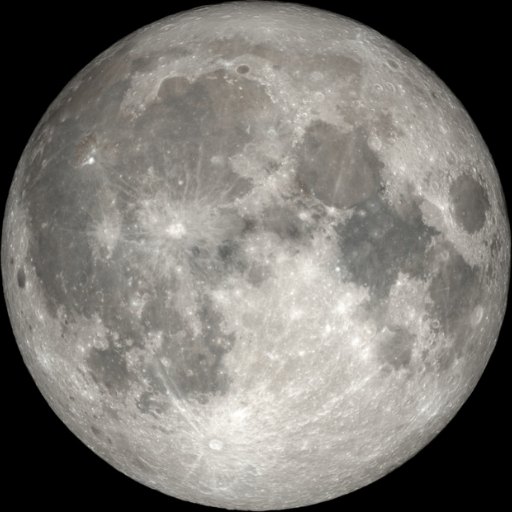
The Moons are astronomy: computed from the real Sun–Moon elongation on each date, accurate to under a tenth of a degree, and checked against the same ephemeris the rest of this site uses. The photograph is a NASA image of the real Moon.
What the pairing says about two people is symbolism, and it is offered as such. The page will not tell you whether to stay or leave. It will tell you, exactly, what the sky looked like on two nights — and let you decide what that is worth.
Questions people ask
Is “moon phase compatibility” real astrology?
Phase-based reading is a genuine part of lunar astrology, but the viral version — two Moons overlapping into a full circle — is a recent internet idea, not a traditional technique. The geometry is real; the romantic conclusion is a modern addition.
What if we have exactly the same moon phase?
Your shapes cover each other instead of completing each other. Traditionally that is read as ease rather than attraction: the same instincts, and the same gaps. It is not a bad result — it is a different one.
Does it work for friends and family, not just couples?
Yes. Nothing in the calculation assumes a romantic relationship — it compares two birth dates. People often run it for a sibling or a close friend and find it more telling than for a partner.
Why is the photograph the same for both Moons?
Because it is the same Moon. It is tidally locked to Earth and always shows us the same face; only the shadow moves. One photograph is therefore correct for every date in history.
Can I check a date before 1900, or a future one?
Yes. The calculation is a series expansion, not a lookup table, so it holds across centuries. It was validated against 380 dates between 1940 and 2015, with a maximum error of 0.073°.
Next: the Moon you were born under, on its own · tonight’s Moon and the phases to come · your Moon sign, which is a different thing entirely