Circles, spirals and ratios that cultures have found sacred for thousands of years — and what they're said to mean.
ℹ️ A documentary guide: we report what these traditions say, as culture and symbolism — you don't have to believe anything to enjoy it.
Look closely at a sunflower, a nautilus shell, a snowflake or a galaxy and you'll find the same handful of shapes and proportions repeating. Sacred geometry is the old, cross-cultural idea that these patterns aren't random — that there's an order humming underneath the visible world, and that its shapes are worth contemplating. Whether you read that as spiritual or simply as beautiful, here's what the main symbols are and what they've come to mean.
At its simplest, sacred geometry is the study of shapes — the circle, the triangle, the spiral — and of proportions like the golden ratio, that recur throughout nature, art and architecture. From Egyptian temples to Gothic cathedrals, from Islamic tilework to Hindu mandalas, builders and mystics have used the same forms to suggest harmony, wholeness and a hidden order.
The measurable part is real: the golden ratio genuinely appears in shells and flowers; hexagons genuinely tile a beehive. The meanings layered on top — unity, creation, the divine — are a symbolic tradition. That mix of real pattern and human meaning is exactly what makes it so fascinating to sit with.
Myth vs reality
The mythThat these shapes are "powers" — that wearing or staring at them changes reality through some hidden force.
The gentle realityThey're universal patterns — not magic, not a promise. Their power is real but simple: they soothe the eye and invite contemplation.
The mythThat you have to believe in them, learn the clever names, and "activate" them correctly to get anything from them.
The gentle realityThere's nothing to believe or memorise. Noticing which shape draws you, and breathing in front of it, is already enough.
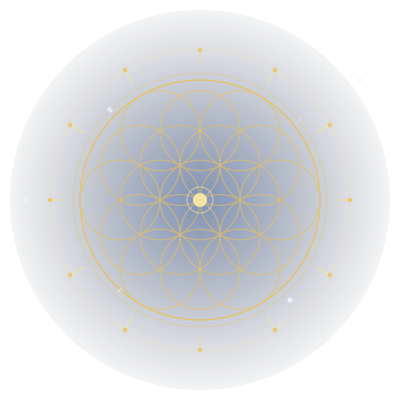
19 overlapping circles in a perfect grid. Carved in ancient temples worldwide — a symbol of creation, interconnection and unity: everything growing from one simple rule.
The five perfectly symmetrical 3D shapes (tetrahedron, cube, octahedron, dodecahedron, icosahedron) — long linked to the classical elements.
A simple way in: you don't need to memorise the names. Notice which shape draws your eye — the endless circle, the growing spiral, the balanced star — and ask yourself why that one feels good right now. That noticing is the practice.
The golden ratio & nature
The most famous piece of sacred geometry is a number: the golden ratio (≈ 1.618), and its cousin the Fibonacci sequence (1, 1, 2, 3, 5, 8, 13…). Count the spirals on a sunflower head or a pinecone and you'll keep landing on Fibonacci numbers. The nautilus grows its shell in a golden spiral; the same proportion shows up in fern fronds, hurricanes and the arms of galaxies.
Artists noticed too — from the Parthenon to Renaissance paintings — using the ratio because it simply feels balanced to the human eye. Whether that's coincidence, biology, or something deeper is the beautiful open question at the heart of the whole subject.
The Golden Ratio (Phi, ≈ 1.618) The ratio that "feels right" to the eye — the one in the nautilus, the sunflower and the Parthenon. A symbol of balance and harmonious proportion.
The Fibonacci Spiral The sequence 1, 1, 2, 3, 5, 8… drawn as a spiral. Read as an image of growth: each step leaning gently on all the ones before it.
The Merkaba Two interlocking tetrahedrons forming a three-dimensional star. In tradition, a symbol of balance between above and below, matter and spirit — a lovely image of things held together.
✦ ✦ ✦
How people use it today
Most people meet sacred geometry as art and as a focus for calm: a Flower of Life to gaze at while breathing, a mandala to colour, a piece of jewellery worn as a reminder of wholeness. Some use it in meditation the way others use a candle flame — a single, ordered thing to rest the mind on. It also quietly underpins tarot, astrology and numerology, which all arrange meaning into circles, numbers and ratios.
Take from it what helps: a moment of wonder, a reminder that you're part of a larger pattern, or simply a lovely thing to draw. None of it asks you to believe — only to look.
The study of shapes and proportions (circles, spirals, the golden ratio) that recur in nature and that many cultures have treated as symbols of a deeper order. A lens for wonder and reflection, not a science.
What does the Flower of Life mean?
Made of 19 evenly overlapping circles, it symbolises creation, interconnection and unity — everything unfolding from the same simple pattern. It appears carved in temples across the ancient world.
Is sacred geometry real or a belief?
Both, in different ways: the shapes and ratios are real and measurable; the spiritual meanings attached to them are a symbolic, cultural tradition — to explore by curiosity, not as proof.
What is Metatron's Cube?
A figure connecting 13 circles whose lines contain the five Platonic solids — used as a symbol of balance and the building blocks of form.
The teaching explains the mechanism. What is it doing in your life?
Your akashic reading: what your soul came in carrying, what it is here to complete, and what to let go.